
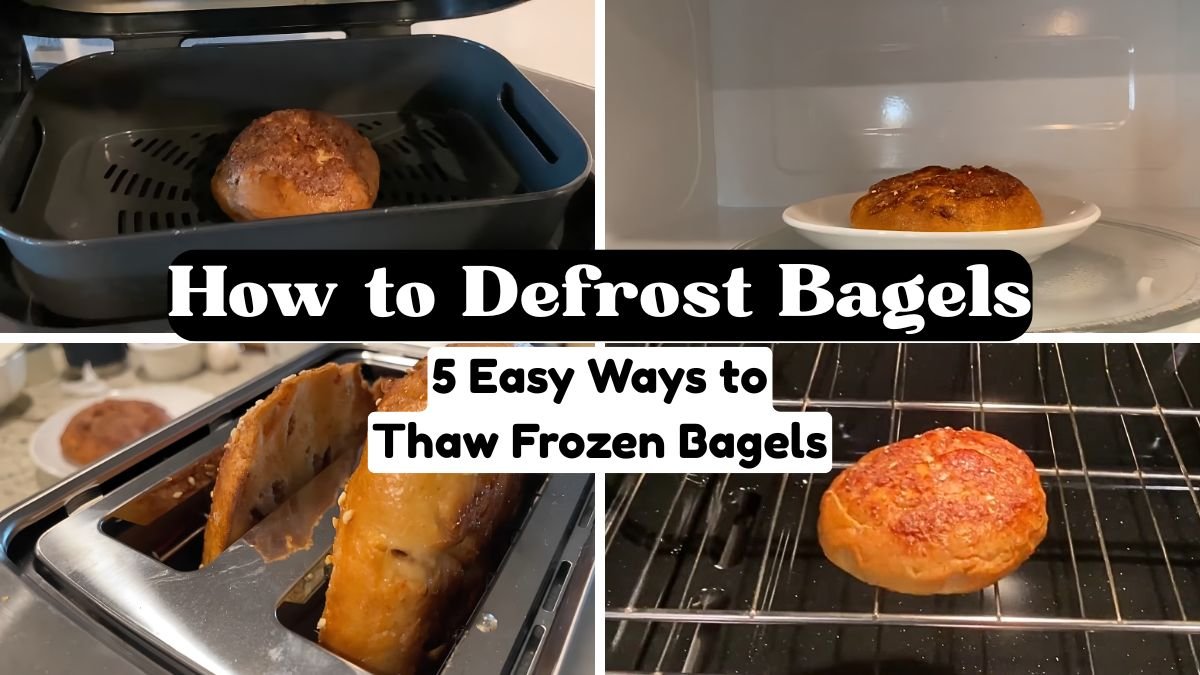
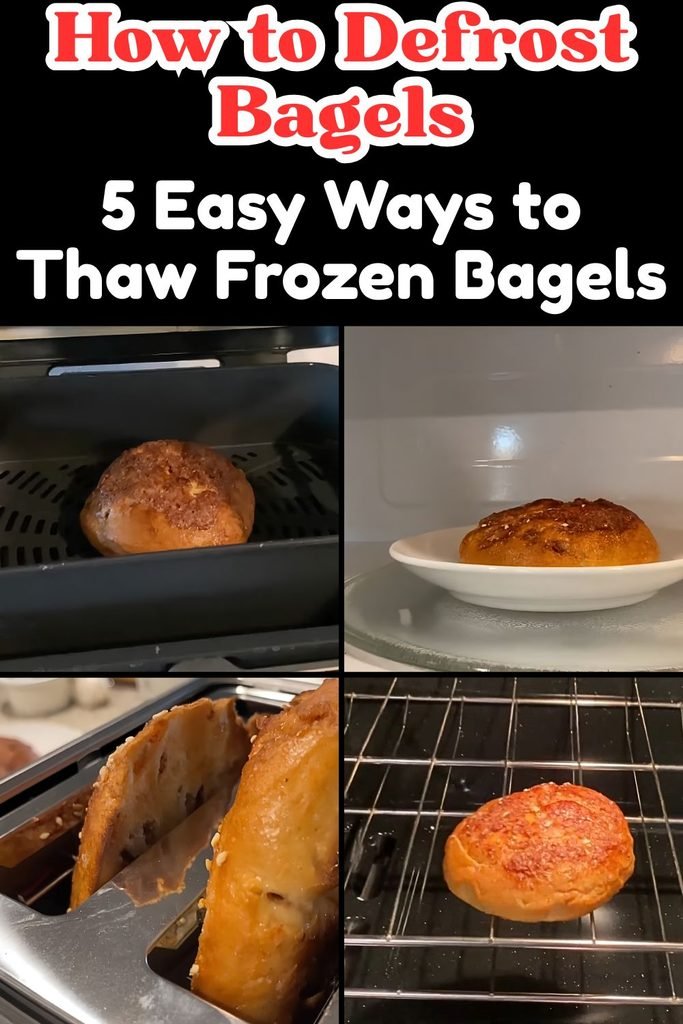
How to Defrost Bagels: 5 Easy Ways to Thaw Frozen Bagels
You pull a bagel out of the freezer, and there it is—hard as a rock!
Now what?
Do you wait for it to thaw? Put it in the microwave? Throw it in the toaster while it’s still frozen? Or maybe use the air fryer?
If you’re wondering how to defrost bagels, the good news is that you usually don’t need to spend much time doing it.
If the bagel is already sliced, I usually skip thawing and toast it straight from frozen. If it is whole, I prefer to soften it first or warm it in the oven or air fryer.
I’ve found that the best method depends less on the bagel itself and more on what I want at the end. If I’m in a hurry, I use the microwave. If I want a crisp outside and soft middle, I reach for the air fryer. If I’m making several bagels, the oven makes more sense.
And if I have a sliced bagel sitting in the freezer?
Straight into the toaster it goes!

Quick Answer: How Do You Defrost a Bagel?
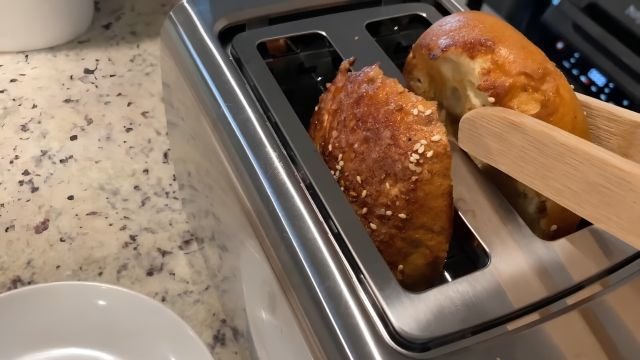
For a sliced frozen bagel, you can usually put it directly into the toaster. If your toaster has a frozen or defrost setting, use it. Some bagel-making and reheating guidance specifically recommends toasting frozen bagel halves directly.
The easiest answer to how to defrost a bagel depends on whether the bagel is sliced or whole.
For a whole frozen bagel, you have a few better choices:
- Microwave: Best when you need it quickly.
- Air fryer: Great for a warm center and slightly crisp outside.
- Oven: Best when you’re warming several bagels.
- Refrigerator: Best when you’re planning ahead.
- Room temperature: Possible for a plain bread product, but it isn’t the method I rely on.
If I had to pick one quick method for a whole frozen bagel, I’d use the microwave followed by the toaster.
The microwave softens the frozen center, while the toaster gives the cut side some crunch.
That’s a much better combination than trying to make the microwave do everything.
Best Bagel Defrosting Methods at a Glance
| Method | Approximate time | Best for | My pick |
|---|---|---|---|
| Toaster from frozen | A few minutes | Sliced bagels | ⭐ Best shortcut |
| Microwave + toaster | About 1–2 minutes | Quick breakfast | ⭐ Best fast method |
| Air fryer | About 3–10 minutes | Whole bagels | ⭐ Best texture |
| Oven | About 10–15 minutes | Several bagels | ⭐ Best for batches |
| Refrigerator | Several hours/overnight | Planning ahead | ⭐ Easiest hands-off option |
| Room temperature | Varies | Simple thawing | Not my first choice |
The times are starting points. A thick bagel, a powerful microwave, or a hot air fryer can change the result quite a bit.
Do You Even Need to Defrost a Frozen Bagel?
This is the first thing I’d ask before doing anything to that frozen bagel.
If it is already sliced, probably not.
A sliced bagel can usually go directly into the toaster. In fact, King Arthur Baking recommends putting frozen bagels directly into the toaster for reheating in one of its bagel recipes.
That is the method I like most for a normal breakfast.
Why thaw something that you’re going to toast anyway?
The toaster warms the frozen bread while browning the cut side. You don’t have to wait for the bagel to soften, and you don’t have to dirty another dish.
The situation changes if the bagel is whole.
A whole frozen bagel is dense and difficult to cut. I would not try to force a knife through it while it’s frozen solid. Let it soften first or use an appliance that can warm the whole bagel.
Your goal matters, too.
If you want:
- A toasted bagel: Toast it from frozen if it’s already sliced.
- A soft bagel: Thaw it first.
- A quick breakfast: Microwave it briefly.
- A crisp outside: Use an air fryer or toaster.
- Several warm bagels: Use the oven.
- Breakfast tomorrow: Thaw it in the refrigerator.
Once you look at it this way, the question isn’t really “What’s the correct way to defrost a bagel?”
It’s:
“What do I want my bagel to be like when I’m finished?”
That makes the answer much easier.
1. How to Defrost Bagels in the Microwave
When I need a frozen bagel quickly, the microwave is the obvious choice.
It’s fast—really fast—but there is one little problem.
Bread can go from soft to rubbery surprisingly quickly in a microwave.
If you’re looking for how to defrost bagels quickly, the microwave is usually the easiest option.
So don’t treat the microwave like an oven. You’re not trying to cook the bagel. You’re simply trying to remove enough of the chill and ice so that the bagel becomes soft.
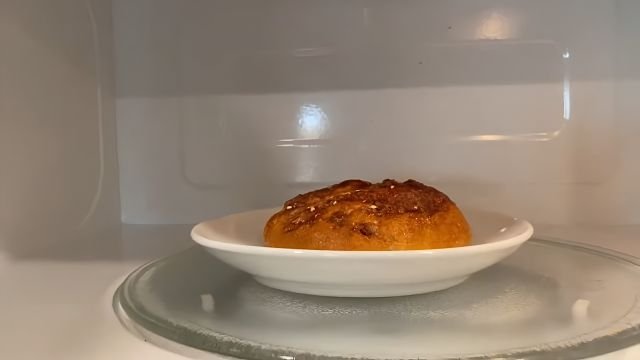
Here’s the method I use:
- Remove the bagel from any packaging that isn’t microwave-safe.
- Place it on a microwave-safe plate.
- Wrap it loosely in a slightly damp paper towel.
- Use the defrost setting or reduced power.
- Heat for about 15–20 seconds.
- Check the bagel.
- Continue in short bursts if needed.
- Stop as soon as the bagel is soft enough.
Whirlpool also recommends short microwave heating periods and a moist paper towel when softening hard bagels, while warning that too much microwave time can make the bagel harder instead of softer.
That last part is important.
Don’t keep microwaving just because the center isn’t hot yet.
If the outside is getting hot while the center remains cold, you’re going in the wrong direction.
Lower the power and use shorter bursts.
How Long Does It Take to Defrost a Bagel in the Microwave?
Start with about 20–30 seconds at reduced power, then check it.
That’s a starting point—not a rule carved in stone.
A small bagel may need less time. A large, dense bagel may need more.
Microwave wattage matters, too. A powerful microwave can heat a bagel much faster than an older model.
I prefer checking the texture instead of relying completely on the clock.
Press the thickest part gently.
If it still feels like a frozen brick, give it another short burst.
If it feels soft and flexible, stop.
If you’re planning to toast it, you don’t even need to make it hot. You just need it soft enough to handle.
Then let the toaster finish the job.
How to Keep a Microwaved Bagel From Getting Rubbery
This is where people usually go wrong.
They put the bagel in for a long time at full power because they’re hungry.
I understand the temptation!
But that’s exactly how you get that chewy, almost rubber-like texture.
Instead:
- Use reduced power.
- Heat in short bursts.
- Check between each burst.
- Use a slightly damp paper towel.
- Stop once the bagel is soft.
- Toast it afterward if you want a crisp surface.
A microwave is excellent at softening bread.
It is not excellent at making toast.
Let each appliance do the job it’s good at.
2. How to Defrost a Frozen Bagel in the Oven
The oven isn’t the fastest way to thaw a bagel, but I really like it when I want the bagel to feel warm and freshly revived, not simply unfrozen.
There’s a difference.
A bagel can be completely thawed and still taste dry or stale. Gentle oven heat can improve the texture at the same time.
For a whole frozen bagel, a temperature around 350–375°F is a reasonable starting point.
Some bagel makers recommend briefly wetting the frozen bagel before heating it, then using an oven around 375°F for roughly 12–14 minutes. Other reheating instructions use 350°F and a shorter time, especially when the bagel is wrapped.
That difference is exactly why I wouldn’t tell you that every frozen bagel needs the same number of minutes.
Instead, start checking early.
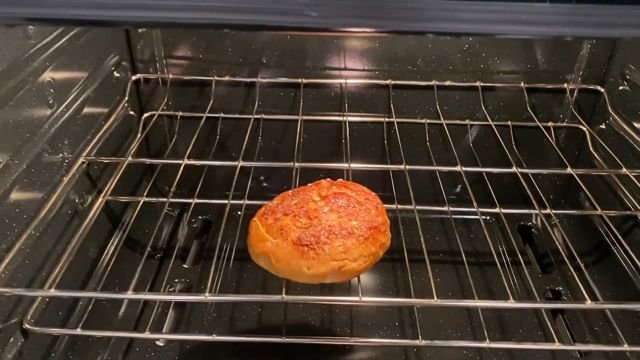
Oven Method
- Preheat the oven to about 350–375°F.
- Place the frozen bagel on a baking sheet.
- If it looks very dry, lightly moisten the outside.
- Wrap it loosely in foil for a softer crust.
- Heat until the center is warm.
- Remove the foil for the last few minutes if you want more crispness.
The foil is optional.
I use it when I want a softer bagel. If I’m after a more toasted crust, I leave the bagel uncovered.
That little change can completely alter the final texture.
How to Stop the Bagel From Drying Out in the Oven
Don’t blast it with high heat.
A frozen bagel needs time for the center to warm. If the oven is too hot, the outside can become hard and dark before the middle is ready.
A little moisture can help. Whirlpool recommends briefly moistening a hard bagel before oven reheating, then wrapping it loosely in foil and warming it at 350°F.
But don’t soak the bagel.
You want a light touch.
Think “slightly damp”, not “I accidentally dropped my bagel in the sink.”
If the bagel is already soft and you just want the crust crisp, skip the moisture altogether.
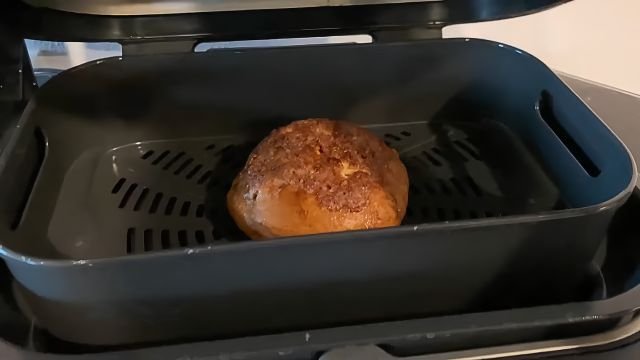
3. How to Thaw Frozen Bagels in an Air Fryer
The air fryer is a great middle ground between the microwave and oven.
It heats faster than a conventional oven and gives you more browning than a microwave.
I especially like it for whole frozen bagels.
Put the frozen bagel into the basket and start around 350–360°F. Check it after a few minutes and add more time if necessary.
There is no universal air-fryer time because machines vary.
For example, one bagel maker recommends 350°F for about 8–10 minutes, while other air-fryer methods use considerably less time.
So don’t blindly copy a 10-minute cooking time from someone else’s air fryer.
Start lower.
Check early.
Add time.
That’s how I’d do it.
Air Fryer Method
- Place the frozen bagel in the basket.
- Set the air fryer to about 350–360°F.
- Start with 3–5 minutes.
- Check the center.
- Add 1–2 minutes if necessary.
- Remove when the center is warm and the outside looks lightly crisp.
If the bagel is very thick, it may need longer.
If it is already sliced, it may need less.
The goal is not to make the crust dark. The goal is a warm middle with the amount of crispness you like.
Should You Wet a Frozen Bagel Before Air Frying?
If the bagel looks dry, a small amount of moisture can help.
Some bagel makers recommend running a frozen bagel briefly under cool water before putting it into the air fryer. Their method uses 350°F for about 8–10 minutes.
I would not soak it.
A quick pass under water is enough.
If your bagel was wrapped well before freezing and still looks moist, you may not need any water at all.
Try the simplest version first.
You can always add moisture next time.
4. How to Thaw Frozen Bagels in the Refrigerator
The refrigerator method is for people who plan ahead.
Move the frozen bagel from the freezer to the refrigerator several hours before you need it, or simply put it there the night before.
Then forget about it.
That’s the beauty of this method.
You don’t need to monitor a microwave. You don’t need to preheat an oven. You don’t need to check an air fryer.
The bagel gradually thaws while staying cold.
For foods that require controlled thawing, USDA recommends refrigerator thawing as one of the safe methods because the food stays at a controlled temperature.
For a plain bagel, the refrigerator is also a convenient way to avoid rushing breakfast.
Once it’s thawed, slice it if needed and toast it.
I still prefer to toast most thawed bagels. A cold, soft bagel is fine, but a warm bagel with a crisp cut side is a completely different experience.
If you’re preparing breakfast tomorrow, this is probably the least stressful option.

How Long Does It Take to Thaw a Bagel in the Refrigerator?
Plan on several hours or overnight.
A sliced bagel will usually thaw faster than a thick whole bagel because the pieces are smaller.
But don’t worry about hitting an exact number.
Check the center.
If it’s soft and flexible, you’re done.
If it’s still hard, give it more time.
The refrigerator method isn’t meant for emergencies.
It’s the method for people who think ahead.
Tonight:
Freezer → refrigerator.
Tomorrow:
Bagel → toaster.
Done.
5. Can You Defrost a Bagel at Room Temperature?
You may see countertop thawing recommended for bagels because they’re a bread product rather than something like raw meat.
However, I wouldn’t make this my main recommendation.
USDA’s general guidance says perishable frozen foods should not be thawed on the kitchen counter because parts of the food can enter temperatures where bacteria can multiply. The agency recommends refrigerator, cold-water, or microwave thawing for foods that require controlled thawing.
A plain bagel is different from raw meat, seafood, or a frozen casserole.
Still, there’s another reason I don’t love countertop thawing:
It takes too long for what you get.
If I want a soft bagel, the refrigerator handles the job with less fuss.
If I’m hungry now, the microwave wins.
If I want a warm, crisp bagel, the oven or air fryer wins.
So while room-temperature thawing is commonly discussed for bread, it simply isn’t the method I’d build my breakfast routine around.
And definitely don’t transfer the same countertop-thawing logic to meat, poultry, seafood, or other perishable foods.
How Long Does It Take to Thaw a Bagel?
The answer depends on how you thaw it.
| Method | Typical starting point |
|---|---|
| Microwave | About 20–60 seconds |
| Toaster from frozen | A few minutes |
| Air fryer | About 3–10 minutes |
| Oven | About 10–15 minutes |
| Refrigerator | Several hours/overnight |
| Room temperature | Varies |
These aren’t guaranteed cooking times.
A thick bagel can take longer than a small one. A whole bagel takes longer to warm than separated halves. Your microwave and air fryer may also perform very differently from mine.
That’s why I prefer checking the bagel rather than blindly following a timer.
If the center is still cold, continue.
If it’s warm and soft, stop.
If the outside is browning too quickly, lower the heat.
It’s really that simple.
What Is the Best Way to Defrost a Bagel?
If you want my practical answer, I’d choose based on the bagel and the situation.
For a sliced bagel
Toast it directly from frozen.
This is the easiest option, and it saves you an entire step. King Arthur Baking also recommends directly toasting frozen bagels in its storage and reheating guidance.
For a whole bagel
Use the air fryer or oven.
Both can warm the center while improving the outside texture.
When you’re in a hurry
Microwave, then toast.
This is the fastest way I’ve found to get both a soft center and a crisp surface.
When you’re planning ahead
Use the refrigerator.
Move the bagel over the night before and toast it in the morning.
When you want the best overall texture
Thaw or warm gently, then toast.
If someone asks me how to defrost bagels and still get a good texture, I’d choose the method based on how the bagel will be served.
That’s the combination I prefer when texture matters more than speed.
How to Defrost a Bagel Without Making It Soggy
A soggy bagel is usually a moisture problem.
The fix isn’t complicated.
If you’re using the microwave, use a slightly damp paper towel rather than soaking the bagel.
If you’re using an oven or air fryer, only add moisture if the bagel is dry.
And don’t seal a warm, damp bagel inside airtight plastic while condensation is collecting around it.
You want enough moisture to keep the bread from drying out—but not enough to make the crust wet.
That’s why I like the microwave-plus-toaster method.
The microwave adds softness.
The toaster removes some surface moisture and adds crispness.
It’s a much better balance.
How to Make a Frozen Bagel Taste Fresh Again
This is where I think many “how to defrost a bagel” guides stop too soon.
Getting rid of the ice doesn’t automatically make the bagel taste fresh.
If a bagel was frozen when it was already stale, thawing won’t magically reverse that. And even a well-frozen bagel can lose some quality over time. USDA notes that freezing preserves food for long periods, but storage time still affects quality.
So if your bagel feels a little dry after thawing, refresh it.
For a dry bagel, I like this approach:
- Lightly moisten the exterior.
- Warm it in the oven or air fryer.
- Slice it if needed.
- Toast the cut side.
- Add your topping while it’s warm.
Whirlpool also recommends oven, microwave, and air-fryer techniques for softening and reviving hard bagels.
That final toast is important.
A thawed bagel can feel merely “okay.”
A warm, toasted bagel with cream cheese?
Much better!
Can You Toast a Frozen Bagel Without Defrosting It?
Yes.
For sliced bagels, this is often the easiest method.
Place the frozen halves directly into the toaster and use the frozen or defrost setting if available.
King Arthur Baking specifically recommends toasting frozen bagels directly for reheating in one of its bagel recipes.
You may need a second cycle depending on the thickness of the bagel and the toaster.
Start with a moderate setting rather than immediately choosing the darkest setting.
If the outside is getting too brown before the inside is warm, lower the setting and give it another cycle.
For a whole frozen bagel, though, I wouldn’t force it into a toaster.
Use the oven or air fryer instead.
Common Frozen Bagel Problems
Why is my bagel rubbery after microwaving?
You probably heated it too long or at too high a power.
Use reduced power and short bursts.
Why is my bagel still frozen in the middle?
The bagel may be thick or completely frozen through. Give it more time at moderate heat instead of increasing the temperature dramatically.
Why is the outside burnt but the center cold?
Your heat is probably too high.
Lower the temperature and allow more time for the center to warm.
Why is my bagel soggy?
Too much moisture may have collected on the surface. Let it dry slightly, then toast it.
Why is my bagel dry after thawing?
It may have lost moisture before or during freezing. Try warming it with a small amount of moisture, then toast it.
Why doesn’t my thawed bagel taste fresh?
Thawing only removes the frozen state. It doesn’t restore the texture of a freshly baked bagel. Toasting or gentle reheating can make a noticeable difference.
How to Freeze Bagels So They Thaw Better
If you’re freezing bagels yourself, the best time to think about thawing is before the bagel goes into the freezer.
I like to slice bagels before freezing them.
That one little step makes future breakfasts much easier.
Instead of taking out a whole frozen bagel and figuring out how to cut it, you can simply grab two frozen halves and put them into the toaster.
Wrap the bagels well and use freezer-safe packaging. Remove as much excess air as practical before sealing the bag.
USDA notes that freezing at good quality and protecting frozen foods properly helps preserve flavor, texture, and overall quality.
I also recommend freezing bagels individually whenever possible.
If you freeze six bagels together in one giant block, you’ll eventually need six bagels.
If you freeze them separately, you can take out exactly one.
That’s a small freezer habit that makes a surprisingly big difference.
Can You Refreeze a Thawed Bagel?
A plain bagel that has been thawed in the refrigerator can generally be refrozen, although repeated freezing and thawing can hurt texture.
USDA notes that foods thawed in the refrigerator can be refrozen, but quality may decrease because of moisture loss during thawing.
For a bagel, that usually means the second thaw may not be quite as good as the first.
I prefer avoiding the problem altogether by freezing bagels individually.
Take one out.
Use one.
Leave the rest frozen.
If the bagel has a perishable filling or topping, don’t automatically apply the same advice. Follow the storage and handling instructions for those ingredients.
Frequently Asked Questions
How do you defrost bagels quickly?
The microwave is the fastest simple option. Use reduced power or the defrost setting and heat in short bursts. For a better texture, toast the bagel after microwaving.
How do you thaw frozen bagels?
You can thaw frozen bagels in the refrigerator, soften them in the microwave, or warm them in an oven or air fryer. If the bagel is already sliced and you want toast, you can usually skip thawing.
How do you defrost a frozen bagel?
For a whole frozen bagel, use the microwave at reduced power in short intervals, or warm it in an oven or air fryer. For a sliced bagel, put the frozen halves directly into the toaster.
How do you defrost a bagel without a microwave?
Use the refrigerator if you’re planning ahead, or use an oven or air fryer if you want the bagel warm at the same time.
Can you toast a frozen bagel?
Yes. Sliced frozen bagels can generally be toasted directly from frozen. A frozen or defrost setting can be useful if your toaster has one.
Can you put a whole frozen bagel in the toaster?
I wouldn’t. A whole bagel can be too thick and may not heat evenly. Use an oven or air fryer instead.
Can you air fry a frozen bagel?
Yes. Start around 350–360°F and check after a few minutes. Depending on the bagel and appliance, it may need several additional minutes. Some bagel makers use 350°F for 8–10 minutes.
How long does it take to defrost a bagel?
A microwave may take less than a minute, while refrigerator thawing can take several hours or overnight. Oven and air-fryer times depend on the appliance and the size of the bagel.
Is it better to thaw a bagel before toasting?
Not necessarily. If it’s already sliced, toasting it from frozen is often the easiest method. For a whole or very thick bagel, warming or thawing it first can help the center heat more evenly.
Can you freeze bagels after they thaw?
If a plain bagel was thawed in the refrigerator, it can generally be refrozen, although its texture may suffer. USDA notes that refreezing thawed food can result in some quality loss from moisture changes.
My Favorite Way to Defrost a Bagel
After trying the different approaches, I don’t think there is one winner for every situation.
For a sliced bagel, I would skip defrosting completely and toast it from frozen.
That’s the easiest method.
For a whole bagel, I prefer the air fryer when I want it quickly and the oven when I’m warming several.
When I’m really hungry and don’t want to wait?
Microwave first, toaster second.
That combination gives you the best of both worlds. The microwave softens the frozen center, and the toaster gives the outside the texture I actually want from a bagel.
And if I’m planning breakfast the night before, I’ll move the bagel into the refrigerator.
The biggest thing I’ve learned is that defrosting and reheating aren’t the same job.
Defrosting gets the bagel soft.
Reheating brings back the warmth.
Toasting brings back the crunch.
Once you know how to defrost bagels without drying it out, keeping a few in the freezer becomes much more useful.
It’s just breakfast waiting for a little heat!
You May Also Like
Love experimenting with kitchen appliances? Check out our guide comparing the Iceman Slush-Ease vs Ninja Slushi to see how these two frozen drink machines compare.





One Comment