
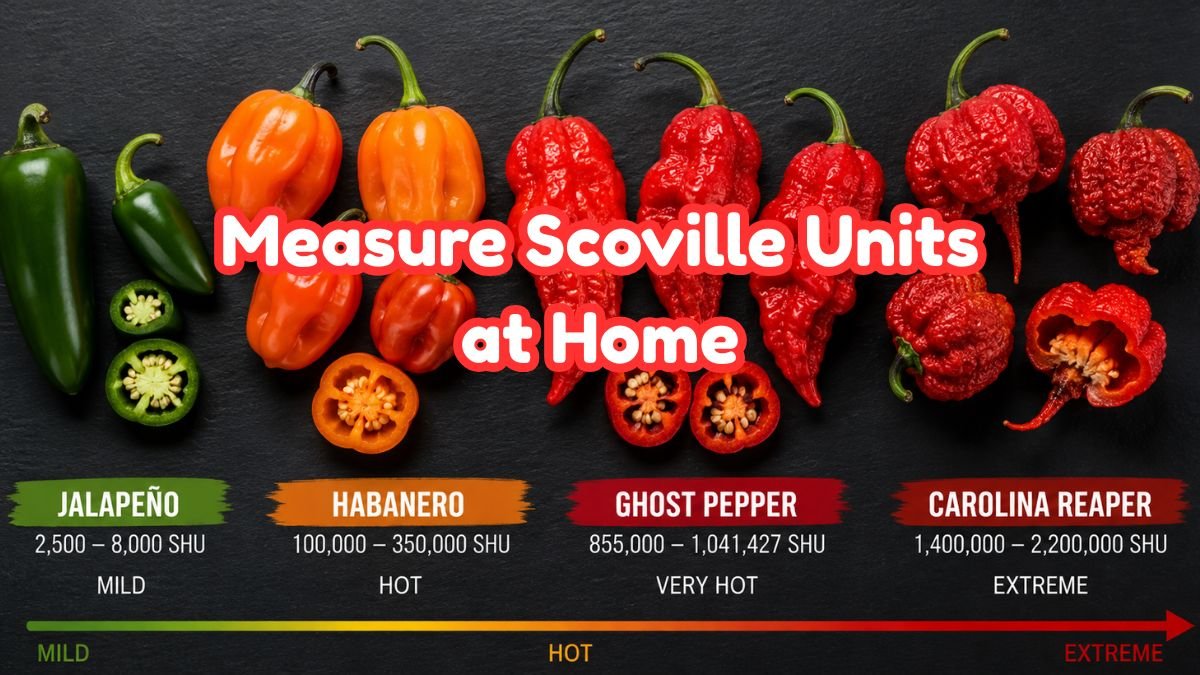
How to Measure Scoville Units at Home: DIY Methods, Accuracy, and Safety
You can estimate heat at home, but you usually cannot get an accurate, lab-grade SHU number with kitchen tools. How to Measure Scoville Units at Home is a useful starting point if you want to compare peppers or sauces, but simple comparisons are not a replacement for laboratory testing.
I’ve compared peppers and homemade sauces side by side, and the biggest lesson is that “hot” is not always easy to put into a number. A pepper can vary a lot from one fruit to the next.
Scoville Heat Units (SHU) describe pungency from capsaicinoids, not temperature, acidity, or pH. Modern testing usually measures those compounds with chemical analysis such as HPLC.
If you’re working with superhot peppers or concentrated products, safety isn’t optional—it’s part of the process.
For home testing, I prefer methods that help me compare heat without pretending I’ve created a certified Scoville measurement.
What Are Scoville Heat Units?
Definition of SHU
Scoville Heat Units are a way of expressing how strongly a pepper or pepper product produces a hot, burning sensation. The scale was developed by pharmacist Wilbur Scoville in 1912. His original method used a pepper extract that was diluted repeatedly until trained tasters could no longer detect its pungency.
The basic idea was simple: the more dilution needed before the heat disappeared, the higher the Scoville rating. Modern testing is much more objective. Laboratories can measure capsaicinoids directly and use those results to calculate a corresponding SHU value. HPLC, or high-performance liquid chromatography, is one common laboratory approach.
I treat SHU as a standardized way to talk about heat, not a kitchen measurement I can perfectly replicate at home.
What Causes Pepper Heat?
The heat in hot peppers comes mainly from a group of compounds called capsaicinoids. Capsaicin is the best-known one, but it is not the only compound involved. Dihydrocapsaicin and several other related compounds also contribute to pungency.
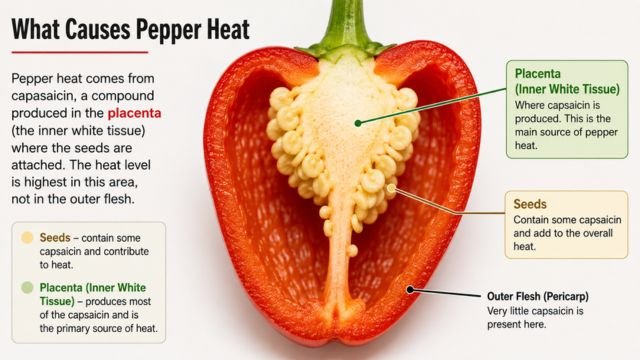
The highest concentration is generally associated with the placenta, the pale inner tissue where the seeds are attached. The seeds can have capsaicinoids on their surface because they contact this tissue, but they are not the main source of heat themselves.
The main capsaicinoids include:
- Capsaicin — the best-known pungent compound.
- Dihydrocapsaicin — another major contributor to pepper heat.
- Nordihydrocapsaicin — present in smaller amounts.
- Minor capsaicinoids — several related compounds can contribute to overall pungency.
In my own comparisons, removing the seeds didn’t make a fiery pepper mild—the inner white tissue matters much more.
Why the Same Pepper Variety Varies
One of the biggest mistakes people make is treating a pepper variety as if it has one exact SHU number. In reality, pepper heat can vary because of genetics and growing conditions. Research has found that factors such as growing conditions and water stress can affect capsaicinoid production.
Some of the variables include:
- Genetics and cultivar
- Ripeness at harvest
- Growing temperature and sunlight
- Water stress and irrigation
- Soil and fertilizer
- Fruit position on the plant
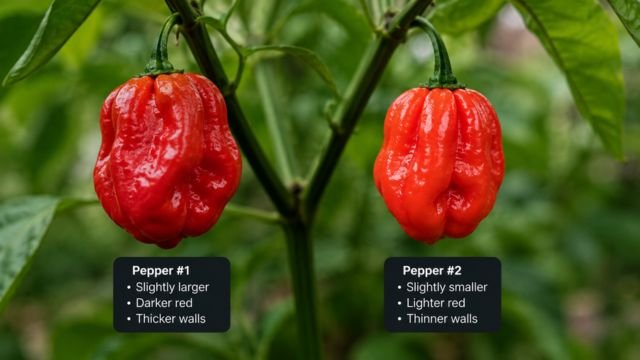
I’ve pulled two peppers from the same plant, on the same day, and found one noticeably hotter than the other. That is why published SHU figures are best treated as ranges rather than promises for every individual fruit.
Three Ways to Measure Pepper Heat
In the hot-sauce community, we usually think about heat in three broad ways: sensory comparison, serial dilution, and laboratory chemical testing. They answer slightly different questions.
| Method | Can you do it at home? | Accuracy | Best use |
|---|---|---|---|
| Sensory comparison | Yes | Very low | Ranking peppers by perceived heat |
| Serial dilution test | Yes, with major safety limits | Low to moderate for comparisons | Rough relative heat estimation |
| HPLC laboratory test | Usually no | High | Accurate SHU reporting |
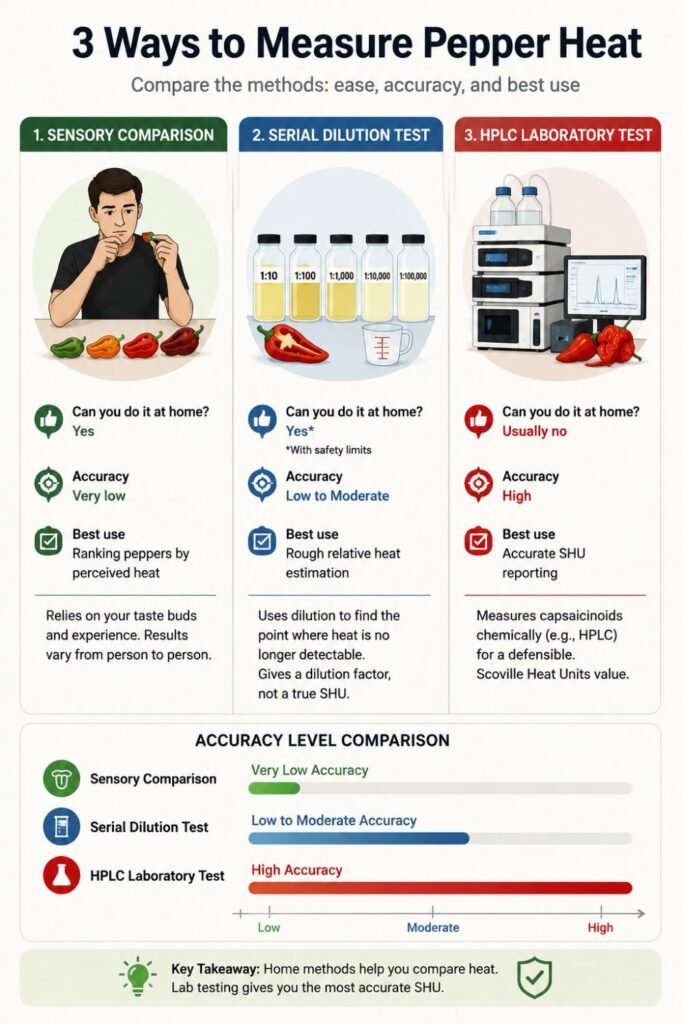
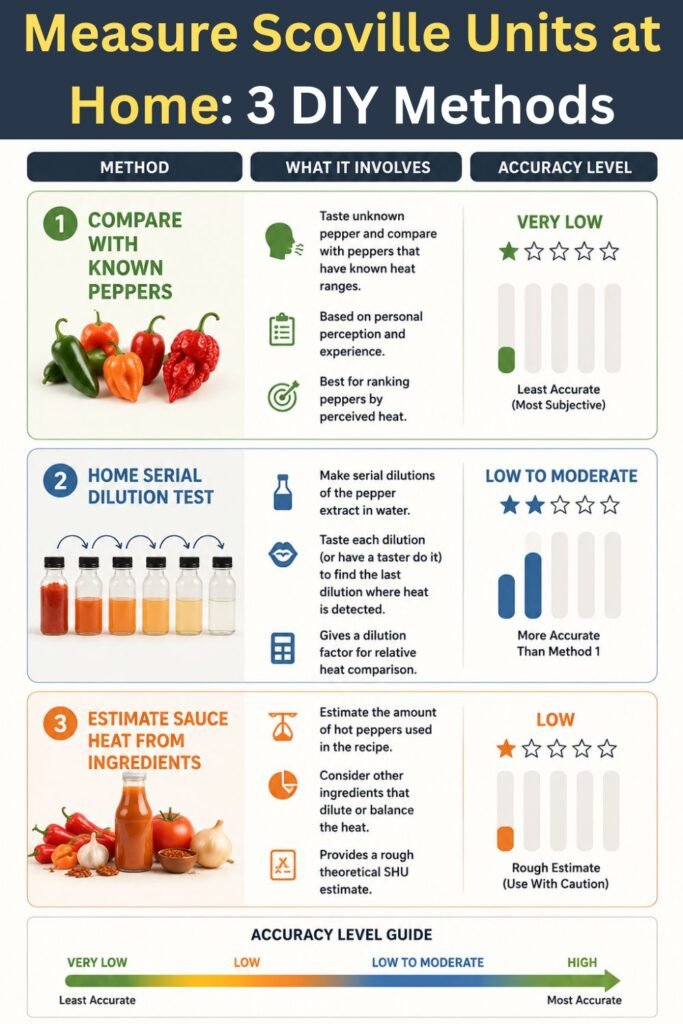
Sensory comparison is the easiest, but your mouth is not a calibrated instrument. A home serial dilution test can give you a repeatable dilution factor, but that factor should not automatically be called an SHU value. HPLC Scoville testing is the better choice when you need a defensible number.
How to Measure Scoville Units at Home: 3 Methods
There are three simple ways to estimate pepper heat at home. Comparing known peppers is the easiest, a serial dilution test is the best home method for a more consistent comparison, and an ingredient-based estimate can help with homemade sauces.
None of these methods gives you a certified SHU number, but they can still help you compare heat.
Method 1: Compare with Known Peppers
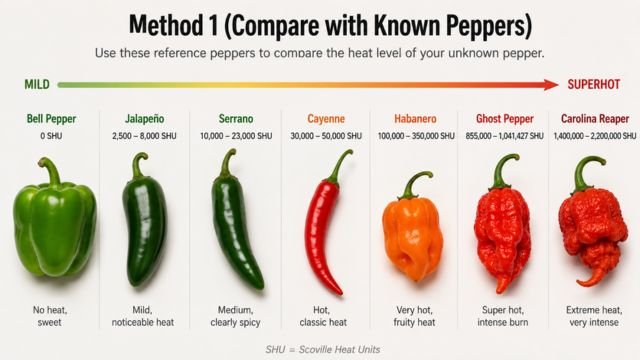
This is the simplest way to measure pepper heat at home. Instead of trying to calculate an exact number, you compare an unknown pepper with peppers whose heat range is already reasonably well documented.
I keep a small “heat library” in mind when comparing peppers. For example, I might compare an unknown pepper with a familiar mild pepper and then with a hotter reference. The goal is not to announce, “This pepper is exactly 82,000 SHU.” The goal is to say something more useful, such as, “This batch seems hotter than my usual habaneros but less intense than my superhot reference.”
If you want to make your comparison more consistent:
- Choose reference peppers carefully. Use peppers with reasonably established published ranges.
- Keep portions consistent. A tiny piece of one pepper compared with a large piece of another can give misleading results.
- Test from milder to hotter. This reduces the chance that an earlier hot sample dominates your perception.
- Give yourself time between samples. The burning sensation can linger.
- Record the heat level and duration. Note how quickly the heat appears and how long it lasts.
- Repeat the comparison. One tasting is not enough to make a strong conclusion.
- Record flavor separately from heat. Sweetness, acidity, bitterness, and aroma can change how intense a pepper seems.
- Use a range instead of a precise number. Say “similar to,” “milder than,” or “hotter than” rather than inventing an exact SHU figure.
There are several limits to this approach:
- Human heat sensitivity varies.
- Previous exposure can affect how strong a sample feels.
- Sugar, fat, acidity, and other ingredients can change perceived heat.
- The size and composition of the sample matter.
- It does not produce a defensible laboratory SHU number.
For me, this method is best when the question is simply, “Which one is hotter?” It is fast, cheap, and useful as long as I label the result honestly.
Method 2: Home Serial Dilution Test
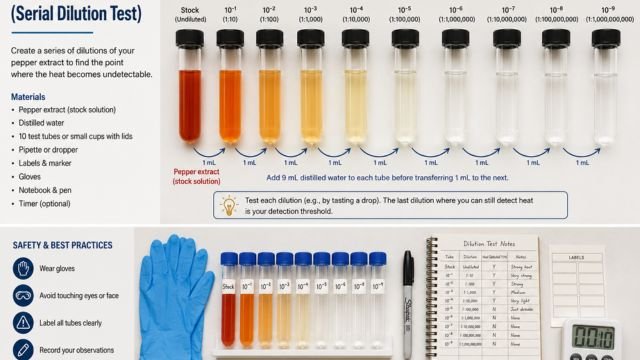
A serial dilution test is based on the same basic idea behind the original Scoville method: dilute a sample repeatedly and observe how far the dilution goes before the pungency is no longer detectable. The original test used trained human tasters, while modern laboratories can measure capsaicinoids directly.
There is an important difference, though. A home dilution experiment gives you a dilution factor, not automatically an SHU measurement.
Safety warning
This is the part I would take most seriously. Concentrated pepper products can cause intense irritation, and you should not treat a DIY test like a challenge. I would never encourage repeatedly tasting concentrated superhot pepper, pepper extracts, or an unknown high-strength product just to chase a number.
If you are handling very hot peppers, avoid touching your eyes, face, or other sensitive areas. Wash equipment and hands carefully after handling them. Gloves can reduce accidental contact, but they do not make concentrated pepper products harmless.
The safest home approach is to use this concept for controlled comparison and record keeping rather than repeatedly exposing yourself to increasingly concentrated samples. If you need a genuine SHU result for a commercial sauce or product label, send a properly prepared sample to a qualified laboratory.
Materials
For a simple, non-laboratory comparison setup, you would want:
- A kitchen scale with a useful resolution
- Clean measuring containers
- Measuring spoons or, better, graduated measuring equipment
- Clean water or another suitable diluent for a non-commercial experiment
- Labels and a permanent marker
- A notebook or spreadsheet
- Disposable gloves for handling hot peppers
- Clean utensils
- A timer
The equipment helps with consistency, but it does not turn a kitchen experiment into certified chemical analysis.
Sample preparation
For a pepper sample:
- Use a representative sample rather than one unusually small or damaged fruit.
- Record whether the pepper is fresh, dried, fermented, or cooked.
For a sauce sample:
- Mix the sauce thoroughly so the pepper material is distributed as evenly as possible.
- Record the recipe, batch size, pepper amounts, and major ingredients.
My biggest rule here is consistency. If you change the sample preparation between tests, your dilution results become much harder to compare.
Fixed dilution ratio
A serial dilution works best when the dilution ratio stays the same from one round to the next. A 1:10 dilution means one part sample is combined with enough diluent to make ten parts total.
For a conceptual home experiment, the important rules are:
- Use the same ratio for every round.
- Use the same type of diluent throughout.
- Keep sample volumes consistent.
- Label every round clearly.
- Do not treat the final dilution as an SHU number.
- Avoid tasting concentrated or unknown superhot samples.
The original Scoville process also relied on trained sensory judgment, which is one reason a casual kitchen test cannot reproduce an official laboratory result.
Step-by-step testing process
If your goal is to compare two relatively safe samples rather than create a certified SHU value, a controlled dilution experiment can be organized like this:
- Choose your samples. Decide which pepper or sauce you want to compare.
- Prepare matching samples. Make the starting conditions as similar as possible.
- Choose one dilution ratio. Do not change the ratio halfway through the experiment.
- Label each dilution clearly. Number the containers so you do not lose track.
- Record the exact amounts. Write down the sample and diluent amounts for every round.
- Repeat the process consistently. Each new round should use the same dilution rule.
- Record observations separately. Note aroma, flavor, visible texture, and perceived pungency rather than forcing everything into one number.
- Repeat the comparison on another day if needed. A single session can be affected by fatigue and sensory adaptation.
- Compare samples using the same method. This is more useful than comparing unrelated experiments.
- Report the result as a dilution factor. Do not convert it into an official SHU value unless you have a scientifically validated method for doing so.
My personal reflection is simple: the value of this experiment is in making two samples comparable, not in making a kitchen number look scientific.
Example calculation
Suppose you use a 1:10 dilution ratio for five rounds. The cumulative dilution factor is:
1:10 × 5 rounds = 10^5 dilution
That means the sample has gone through a 100,000-fold dilution under those test conditions. It does not mean the sample is automatically 100,000 SHU.
That distinction is critical. A dilution factor from a homemade test should never be presented as if it were a certified chemical measurement.
Making the test more reproducible
You can make your records much more useful by keeping the conditions consistent:
- Weigh samples instead of relying only on spoon sizes.
- Record the pepper variety and batch.
- Record whether the pepper was fresh or dried.
- Record the sauce recipe and final batch weight.
- Use the same dilution ratio each time.
- Keep containers clean.
- Run comparison samples under the same conditions.
- Record results immediately instead of relying on memory.
- Repeat tests instead of trusting one observation.
- Keep your dilution math separate from any published SHU figures.
These steps improve repeatability, but they still do not create laboratory-grade accuracy.
How to report the result
If I were writing up a home experiment, I would describe exactly what I measured. For example, I might say that one sample remained detectable after more dilution than another, or that a sample reached a certain cumulative dilution under my test conditions.
Phrases I would use:
- “Estimated relative heat”
- “Home dilution result”
- “Reached a 100,000-fold dilution under these test conditions”
- “Appeared hotter than the reference sample”
- “Rough comparison only”
Phrases I would avoid:
- “Laboratory-certified SHU”
- “Exactly 100,000 SHU”
- “Scientifically proven to be 100,000 SHU”
- “Official Scoville rating”
My rule is simple: report what you actually measured, not what you wish the experiment had measured.
Method 3: Estimate Sauce Heat from Ingredients
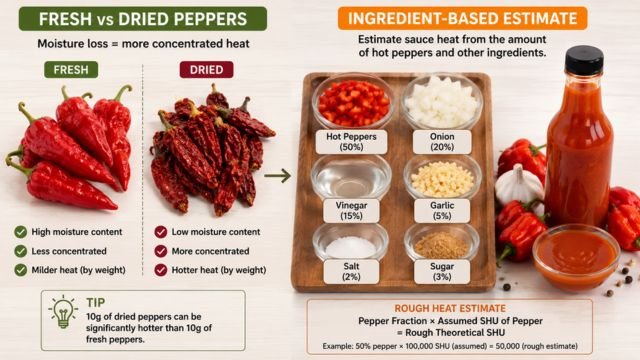
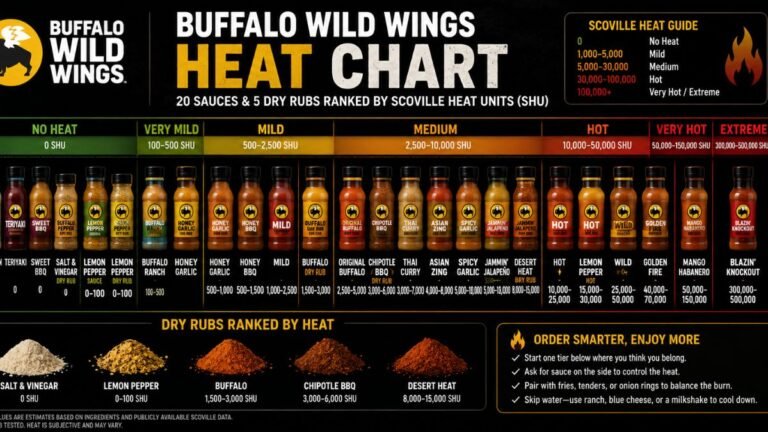
A homemade hot sauce SHU estimate can be useful when you want a rough idea of how hot a finished sauce may be. For a real-world example, see my Buffalo Wild Wings Scoville chart, where the sauce heat levels are presented as estimates rather than laboratory-verified SHU figures.
A simple theoretical formula is:
Estimated SHU ≈ sum of ingredient fraction × ingredient SHU
For example, imagine a sauce made mostly from a pepper with an assumed average of 100,000 SHU. If peppers make up 20% of the finished sauce by weight, a very rough ingredient-based calculation would be:
0.20 × 100,000 = 20,000 SHU
That does not mean the finished sauce actually tests at 20,000 SHU. It is only a theoretical estimate based on the assumptions you entered.
The problem is that pepper SHU itself can vary, and the actual capsaicinoid concentration of your particular fruit may be different from the published average. Research on chili peppers shows that capsaicinoid levels can vary between samples and can be affected by growing conditions.
There are other problems too:
- Pepper ranges can be wide.
- Different fruits from the same plant can differ.
- Pepper weight does not tell you the exact capsaicinoid content.
- Seeds and inner tissue are distributed differently in recipes.
- Cooking and processing can affect the final product.
- Fermentation changes the sauce matrix and other properties.
- Water, fruit, vegetables, vinegar, and other ingredients dilute the pepper material.
- Extracts can completely change the calculation.
Fresh vs. dried peppers
Fresh and dried peppers should not be treated as identical ingredients. Drying removes water, so the pepper becomes more concentrated by weight. Research has also found that moisture can affect extraction efficiency when capsaicin is analyzed chemically.
I learned to be careful with dried peppers because a recipe can look small on paper while carrying a much larger amount of pepper solids than the same weight of fresh peppers.
For a rough estimate, I prefer to state my assumptions clearly. That makes the estimate useful without making it sound like a laboratory result.
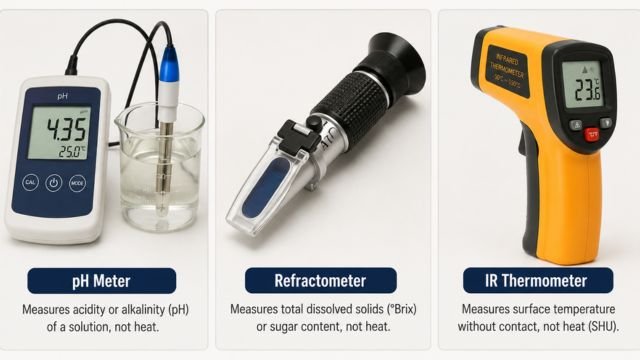
Methods That Do Not Measure Scoville Units
A lot of kitchen tools can tell you something about a pepper or sauce, but they do not directly measure Scoville Heat Units.
- pH meters: These measure acidity. They can be useful for checking sauce acidity, but pH does not tell you how much capsaicin is present.
- Refractometers: These estimate soluble solids, often reported as Brix. Sugar and other dissolved solids can affect the reading, but it is not a heat measurement.
- Infrared thermometers: These measure surface temperature. Pepper “heat” is a chemical sensation, not actual thermal temperature.
- Taste alone: Your tongue can tell you how hot something feels, but personal sensitivity and adaptation make it a poor way to assign an exact SHU number.
- Smartphone apps: An app may calculate an estimate from ingredients or let you record sensory scores, but your phone cannot directly detect capsaicinoid concentration.
- Cheap “Scoville meters”: Be careful with products that promise instant SHU readings. Unless the device uses a validated chemical measurement method, a number on a screen does not make the result laboratory-grade.
I use kitchen tools to understand my sauces, not to pretend they are HPLC instruments.
Safety Notes
- You should never treat a superhot pepper test as a challenge.
- Wear gloves when handling very hot peppers or concentrated products.
- Keep your hands away from your eyes and face while working.
- Wash utensils and work surfaces carefully after preparation.
- Keep milk nearby, not water, if you accidentally get significant pepper heat in your mouth; water does not remove capsaicin well.
- Stop if you feel unwell rather than trying to finish an experiment.
- Keep concentrated pepper products away from children and pets.
- For commercial or serious testing, use a qualified laboratory instead of repeated home exposure.
How Accurate Is This, Really?
I think this is where a lot of home Scoville guides go wrong. A homemade test can be useful, but it is easy to give the result more authority than it deserves. Community discussions about homemade sauces often make the same point: there is no simple kitchen device that turns a sauce into an accurate SHU number, and laboratory liquid chromatography is the reliable route for chemical measurement.
For me, a sensory comparison is good for ranking samples. A controlled dilution experiment can be useful for comparing relative pungency and recording a dilution factor. An ingredient calculation can give a rough theoretical estimate. None of those should be confused with HPLC testing.
If you need to put a defensible SHU claim on a product, I would not rely on a home Scoville test. HPLC can directly quantify capsaicinoids, which is a much stronger basis for reporting heat.
FAQs
Can I measure Scoville units at home?
You can estimate relative heat at home, but you normally cannot produce a certified SHU number with kitchen equipment. I use home methods for comparisons, not official labeling.
How are Scoville units measured today?
Modern laboratory methods can measure capsaicinoids chemically, commonly using liquid chromatography such as HPLC. The measured capsaicinoid concentration can then be converted to a corresponding SHU value.
Is a serial dilution test the same as the Scoville test?
Not automatically. A home serial dilution experiment can show how far a sample was diluted under your chosen conditions, but that dilution factor should not simply be renamed as an SHU value.
Can I calculate the SHU of homemade hot sauce?
You can make a theoretical estimate from the ingredients, but the result can be quite uncertain. Pepper variation, processing, and the amount of each ingredient all affect the final heat.
What is the best way to get an accurate SHU number?
For a serious or commercial claim, laboratory chemical analysis is the better choice. HPLC testing can measure capsaicinoids directly instead of relying only on a person’s perception of heat.



One Comment